
Since 1925
Our history
More than seventeen hundred engagements in Italy and over seventy performances in European cities and the United States. But it all began in a large room in the Rocchetta of Dozza.
- 1925
The Dozza Band is born
A committee of music-loving friends, with the help of the Town Council, sets up the first core of the band: a few brass instruments, clarinets and drums. Its home is a large room in the Rocchetta, at the entrance to the medieval village. On New Year's Day 1926, only ten months later, the band parades through the streets of the village bringing good wishes to the families.
- 1930s and '40s
Between two wars
The line-up grows to 24 instruments and requests arrive for religious festivals in the surrounding parishes. But times are hard: call-ups and military service put the band to the test, and it stays alive by involving the very young. In the early 1940s, reduced to a bare minimum in both numbers and the state of its instruments, it is downgraded to a «fanfara» and then disbands at the darkest moment of the war. It re-forms right after the end of the conflict, sustained by affection for its popular culture and its roots.
- 1960s
The revival
After ups and downs the band finds its best form again. Requests arrive from outside the province too, and a folk dance troupe takes shape, destined to become an integral part of the band.
- 1963
The s'ciucaren arrive
During a social festival at Brisighella, two enthusiasts with whips of the «old cart driver» type join the musicians, cracking in time with the music. They are immediately called s'ciucaren and become part of the band. Read the story of the s'ciucaren.
- 1975
The costume and the folk group
The group chooses a costume that represents the origins of the Romagna land: that of the eighteenth-century Romagnolo in his Sunday best. The folk group is born, with whip-crackers, dance troupe and traditional costume. Discover the costume.
- 2003
A maestro for fifty years
On 30 August 2003 Maestro Fernando Baroncini, conductor since 1953, passes away. Even in his eighties he had the enthusiasm of a boy, and to the very end he tried not to leave his musicians alone, handing over the baton to Carlo Pandolfi.
- 2025
A hundred years of music
The band celebrates the centenary of its founding: a century of tradition, music and Romagna popular culture.
The succession of maestros
From its foundation to today the musical direction has changed hands several times, each time leaving its mark.
- Andrea Pirazzini, first maestro at the foundation, one of the best band trainers and later conductor of the Rome municipal police band.
- Gaetano Musiani, who took over before New Year 1926: the energy of the young combined with the experience of the elder bore excellent fruit.
- Luigi Stefani, from 1930 to 1946-47. With great foresight and a sense of balance he kept the band outside and above party politics, so much so that it was respected even under the regime.
- Maestro Ferri of Imola, for a year, and then Maestro Forlani, who completed the cycle of the «Peregrinatio».
- Giulio Montanari, until 1953.
- Fernando Baroncini, from 1953 to 2003. Called in because the band could not afford an outside conductor, what seemed a stopgap proved to be a stable and winning solution.
- Carlo Pandolfi, who today conducts the Corpo Bandistico Folkloristico Dozzese.
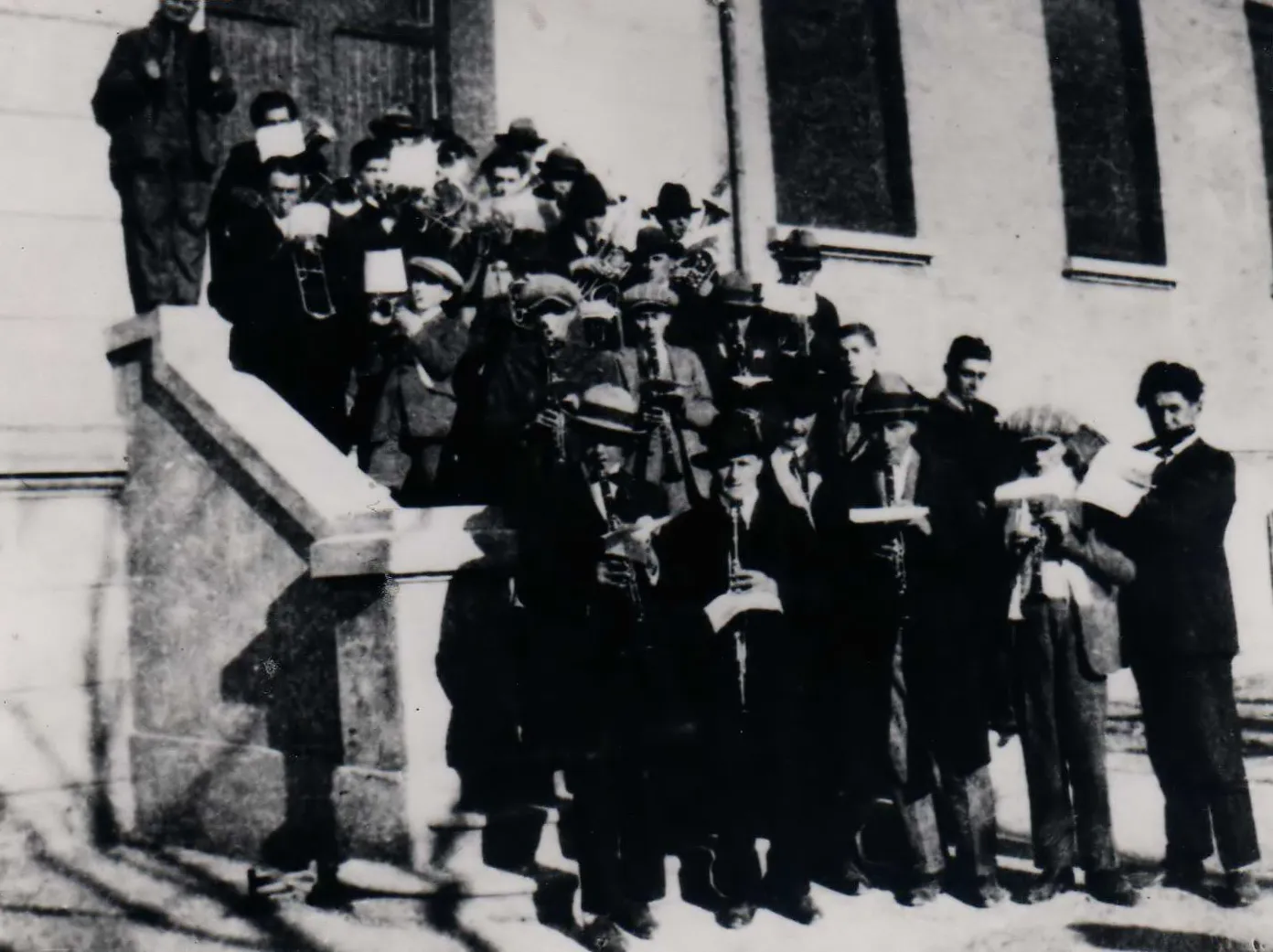
One of the band's first line-ups, in front of Dozza's primary school.
The group has about thirty members, almost all living in Dozza or born and raised there before moving away: clarinets, trumpets, tenor and alto saxophones, basses, alto horns (genis), euphoniums and drums, the s'ciucaren, the dancers and a presenter-singer.